ACM IUI 2026
PersonaMail: Learning and Adapting Personal Communication Preferences for Context-Aware Email Writing
1New York University, Tandon School of Engineering 2City University of Hong Kong
PersonaMail addresses three challenges identified in formative studies through structured communication factor exploration, granular editing controls, and adaptive reuse of successful strategies. Compared against standard LLM interfaces, it showed improved efficiency in both immediate and repeated use, alongside higher user satisfaction.
3key challenges identified in formative studies
16participants in the evaluation
34.8%higher draft quality than standard LLM interfaces
42%faster task completion with adaptive reuse
Why it matters
LLM-assisted writing has seen rapid adoption in interpersonal communication, yet current systems often fail to capture the subtle tones essential for effectiveness. Email writing exemplifies this challenge: effective messages require careful alignment with intent, relationship, and context beyond mere fluency.
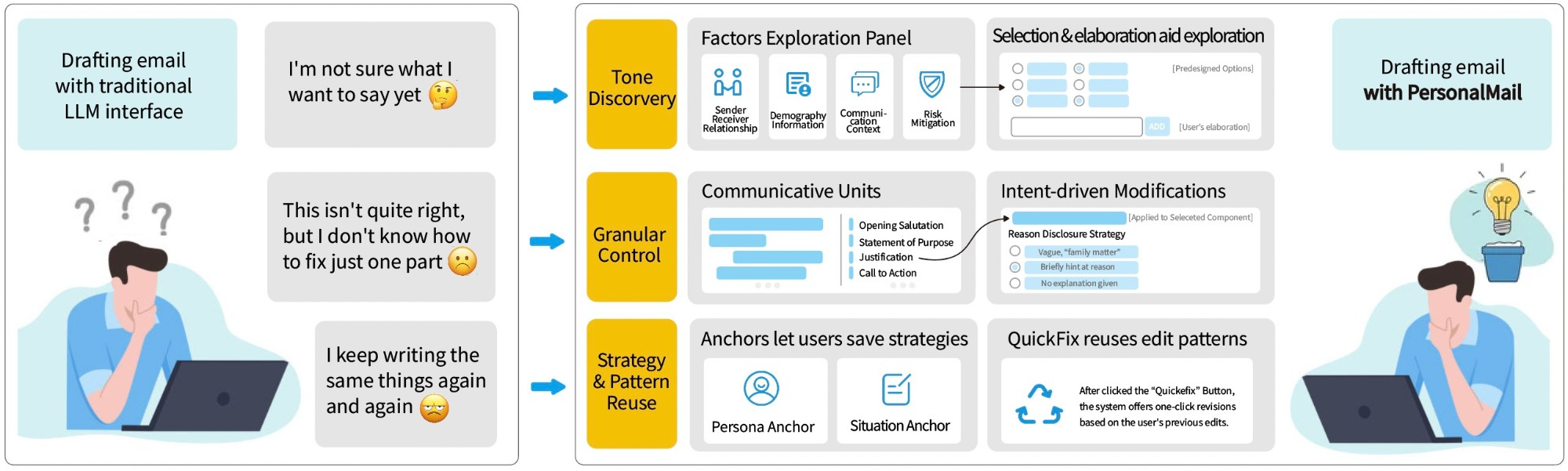
Figure needed:
Paper Fig. 1: PersonaMail overview, contrasting a traditional LLM interface with the structured solution.
assets/projects/personamail/fig1-overview.pngPaper Fig. 1: PersonaMail overview, contrasting a traditional LLM interface with the structured solution.
What the paper did
- Formative studies. Three key challenges: articulating nuanced communicative intent, making modifications at multiple levels of granularity, and reusing effective tone strategies across messages.
- PersonaMail. A system that addresses these gaps through structured communication factor exploration, granular editing controls, and adaptive reuse of successful strategies.
- Evaluation. A user study with 16 participants comparing PersonaMail against a standard LLM interface (Gemini with Gmail).
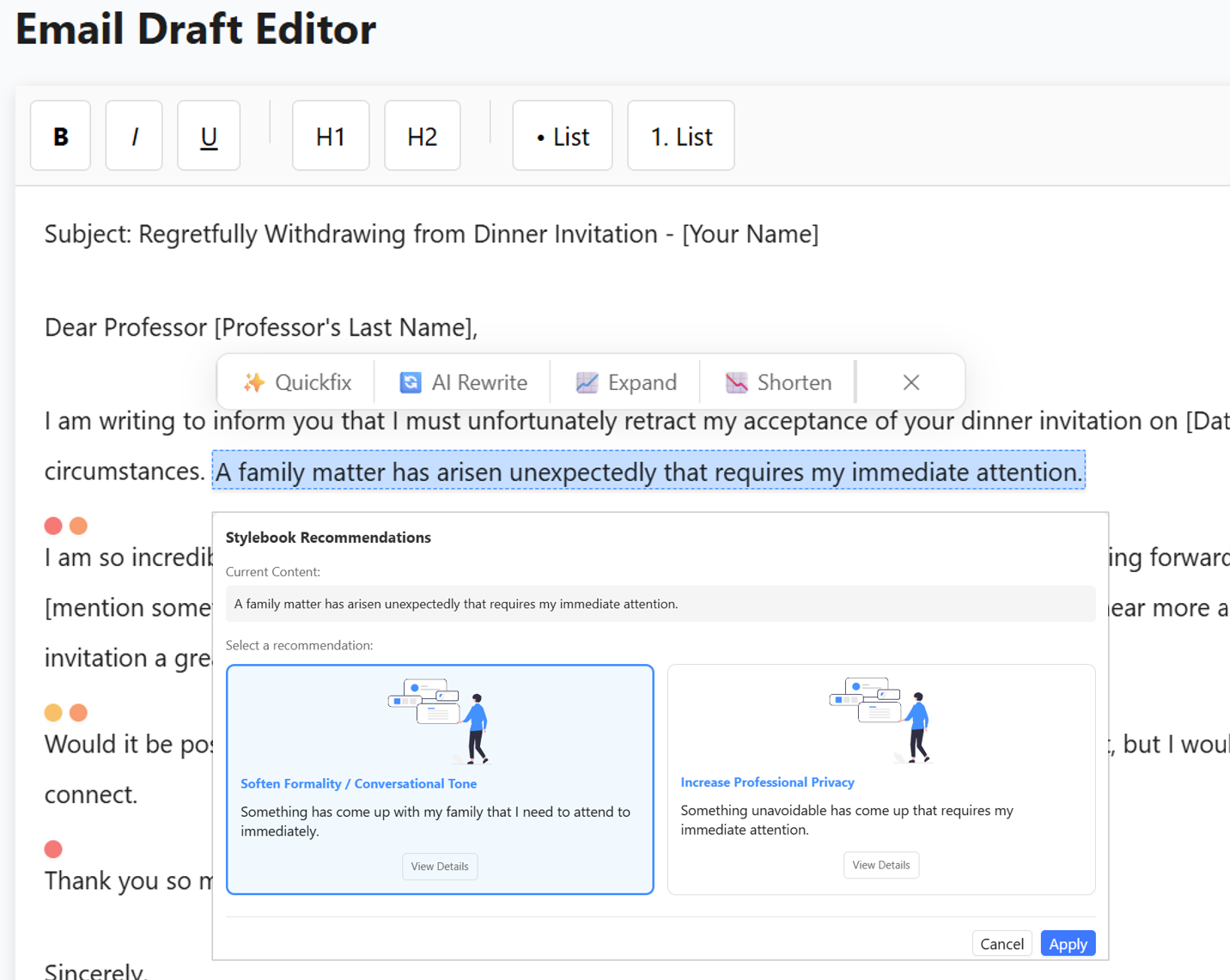
Figure needed:
Screenshot of the PersonaMail editor with Quickfix suggestions.
assets/projects/personamail/editor.pngScreenshot of the PersonaMail editor with Quickfix suggestions.
What the paper found
Higher draft quality, lower cognitive load. Structured factor exploration produced drafts rated 34.8% higher in quality than standard LLM interfaces while reducing cognitive load by 24.5%.
Targeted adjustments halved revision time. Intent-driven modifications and QuickFix enabled 61.94% of revisions through targeted adjustments, halving revision time.
Adaptive reuse reduced setup time. Adaptive reuse reduced setup time by 58.5% in subsequent uses, with 42% faster task completion. First-time use required greater upfront investment in articulation.
Concrete alternatives avoided unproductive deliberation. Rather than becoming trapped in unproductive deliberation, users received concrete alternatives that allowed them to quickly navigate to preferred versions.
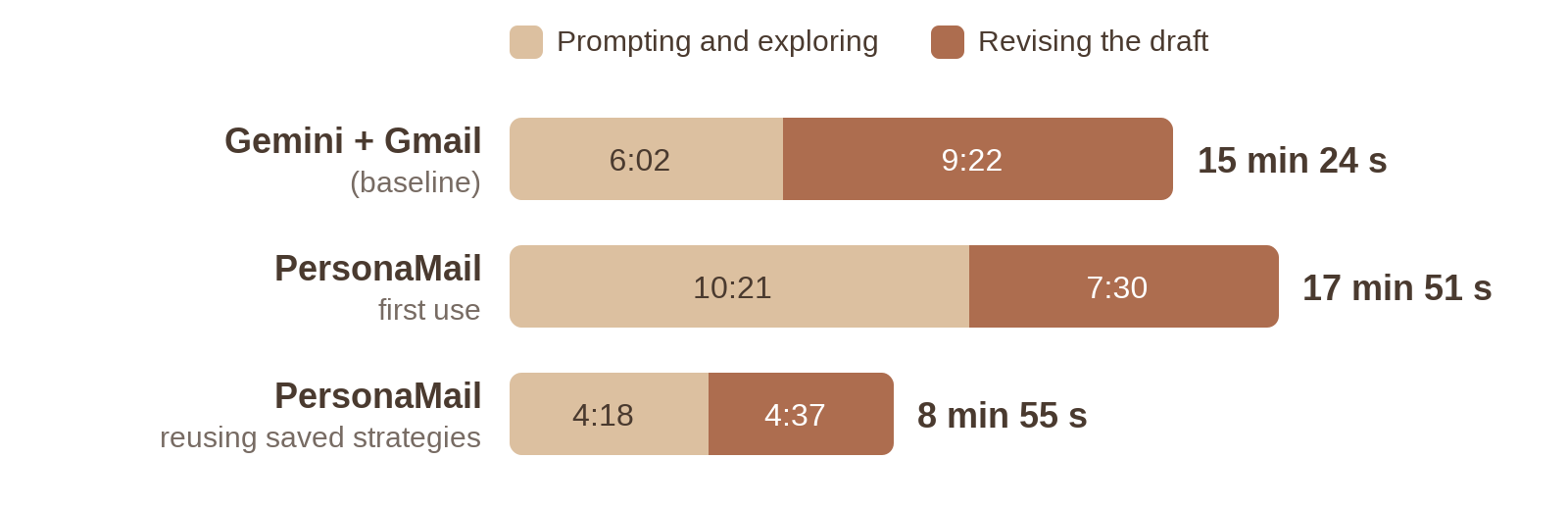
Figure needed:
Simple stacked bars of mean task time.
assets/projects/personamail/time.svgSimple stacked bars of mean task time.
Design implications
- Factor-based scaffolding for intent. Translate tacit social knowledge into explicit, adjustable factors (e.g., relationship closeness, emotional stakes) so users can externalize nuanced goals without articulating every unspoken detail.
- Communicative-unit and intent-driven control. Segment emails into functional sections (e.g., Opening_Salutation, Justification) and expose the AI's underlying reasoning as editable intents, so users can manipulate the social function of message segments without direct text editing.
- Adaptive reuse for continuity. Capture successful strategies as reusable “anchors” that preserve not just content but the underlying social logic.
- Privacy and ethical considerations. Personalized tone learning raises privacy concerns, and adaptive systems may reinforce communication patterns that limit users' expressive range.
Cite
@inproceedings{yao2026personamail,
  title     = {PersonaMail: Learning and Adapting Personal Communication Preferences for Context-Aware Email Writing},
  author    = {Yao, Rui and Ren, Qiuyuan and Tan, Felicia Fang-Yi and Chen, Yang and Zhang, Xiaoyu and Zhao, Shengdong},
  booktitle = {Proceedings of the 31st International Conference on Intelligent User Interfaces},
  series    = {IUI '26},
  year      = {2026},
  publisher = {ACM},
  doi       = {10.1145/3742413.3789123}
}